
How to Generate Mortgage Leads in 2026: 15 Strategies for Mortgage Brokers and Loan Officers
- The 15 mortgage lead generation strategies covered here range from SEO and referral partnerships to paid ads, social media, and local search, with a focus on what produces the highest-quality, highest-close-rate leads.
- Referrals and organic search leads consistently convert at the highest rates because the borrower arrives with trust already established before the first conversation.
- Building an exclusive inbound system takes longer than buying leads but creates a compounding asset. Purchased leads stop the moment the spend stops.
- Local intent keywords like 'VA loan officer in Pensacola' or 'FHA loan Baldwin County AL' generate borrowers who are ready to work with a specific professional, not rate-shopping across five lenders.
- A 30-day lead generation plan is included: week-by-week steps any loan officer or mortgage broker can follow to build consistent pipeline.
How do you generate mortgage leads in 2026? Build a system that combines organic search from a content-rich website, referral partnerships with real estate agents and past clients, and at least one paid or purchased channel for short-term volume. The highest-converting leads arrive through organic search and direct referrals, where borrowers arrive with trust already established. This guide covers 15 practical strategies and how to combine them into a system that compounds over time.
Most mortgage brokers and loan officers don’t have a lead problem. They have a system problem.
They try one tactic for a few weeks, buy a batch of shared leads, post something on Instagram, and then wait. When it doesn’t produce immediate results, they move on to the next thing. The cycle repeats, and their pipeline stays inconsistent.
Knowing how to generate mortgage leads isn’t really the hard part. The hard part is building a repeatable system that produces leads at different stages-fast channels for this month and long-term assets that compound over time. This guide breaks down 15 practical strategies for generating mortgage leads in 2026, from quick wins to foundational organic channels, and explains how to think about combining them.
I spent over 10 years as a licensed mortgage loan originator and two years as a HUD-certified housing counselor before shifting to marketing. That background matters here because the advice in this guide isn’t borrowed from a generic digital marketing playbook. It comes from working the same pipelines these strategies are supposed to fill.
To generate mortgage leads in 2026, build a system that combines owned organic assets, referral partnerships, and at least one paid channel. The highest-quality leads arrive through two paths: organic search from a content-rich website borrowers find before they are ready to call, and direct referrals from real estate agents and past clients who send trust along with the contact. After 10 years originating loans in purchase-driven markets and two years as a HUD-certified housing counselor, the pattern is consistent: brokers with a disciplined inbound system close more loans at lower cost per funded loan than brokers chasing volume through shared lead sources. This guide covers 15 practical strategies and explains how to combine them into a system that compounds over time.
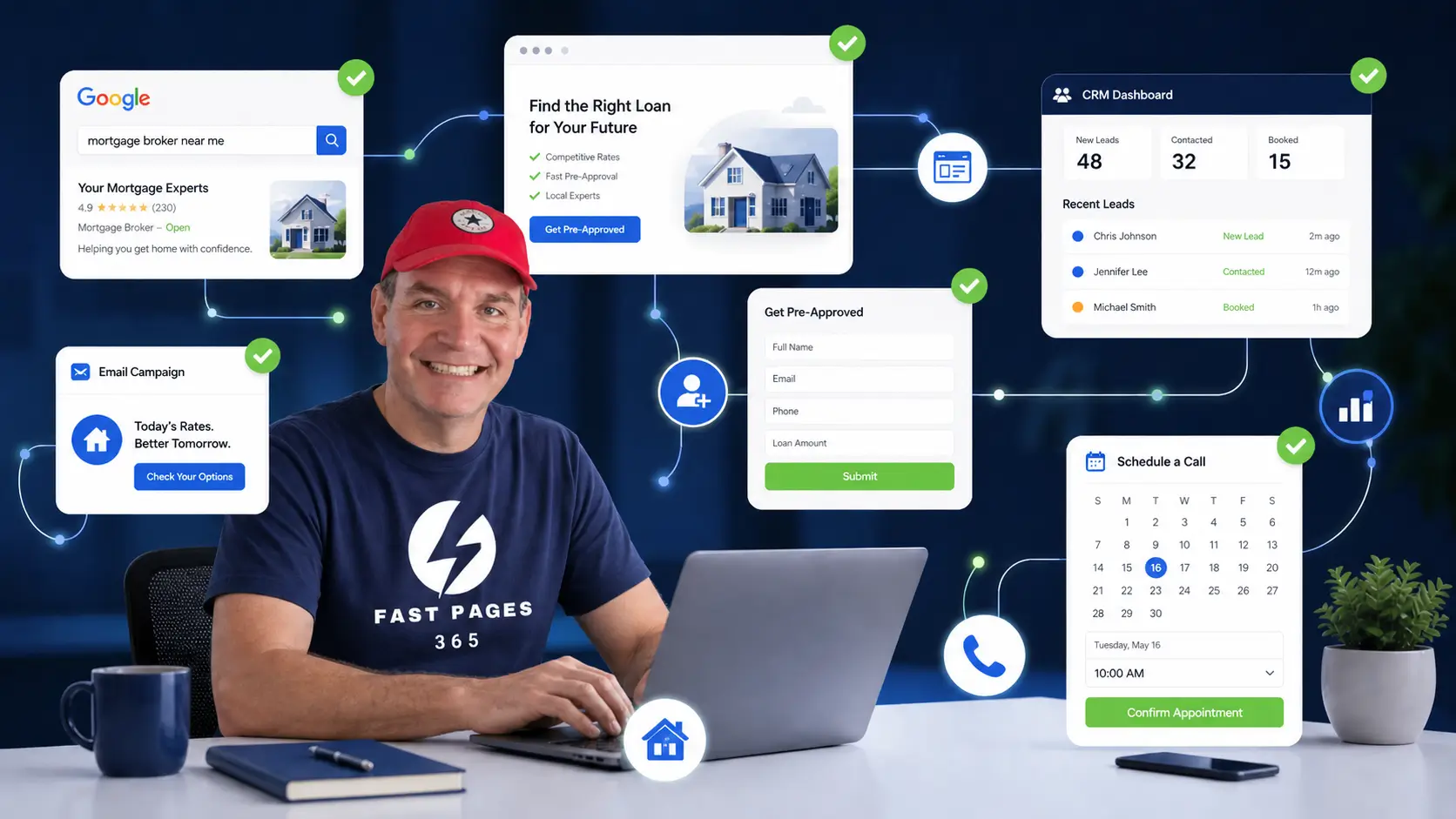
What counts as a mortgage lead?
A mortgage lead is any potential borrower who has expressed interest in buying, refinancing, or learning about a home loan product.
Not every “lead” has the same value, and treating them all the same is one of the biggest mistakes brokers make.
Here’s a useful way to think about it:
- A name in a database - Someone who filled out a form somewhere, maybe years ago, for a different purpose. Low intent.
- A shared internet lead - A borrower who submitted their info on a lead aggregator or comparison site. That same lead was sold to several brokers. You’re racing to call first.
- An exclusive inquiry - A borrower who contacted you or your site directly, or a lead sold only to you. Higher intent, no competition.
- A referral - A borrower sent to you by someone they trust. Usually the highest conversion rate of any source.
- An organic search lead - A borrower who found your content or website while actively researching their loan options. High intent because they came to you.
The type of lead you’re generating determines how you should qualify it, respond to it, and close it. Volume alone is not a strategy.
Why does mortgage lead quality matter more than volume?
Mortgage lead quality matters more than volume because high-intent borrowers convert at far higher rates than shared or low-intent leads.
A loan officer chasing 200 shared leads a month may close fewer loans than one working 40 exclusive or referral leads. The difference is intent and exclusivity.
Shared leads often have these problems:
- The borrower doesn’t remember submitting their information
- They’ve already been contacted by three competitors
- The lead is days or weeks old by the time it reaches you
- Their loan scenario doesn’t match your products
Quality signals to look for: Did the borrower initiate contact? Do they know who you are before you call? Are they in your geography and loan type sweet spot? Is the lead exclusive to you?
Speed-to-lead matters enormously with lower-quality leads-response time within five minutes can triple contact rates. But with organic search leads and referrals, the borrower already has some trust built before they reach you. That changes everything.
What are the best ways to generate mortgage leads in 2026?
The best mortgage lead sources combine SEO, referral partnerships, local search, paid ads, lead magnets, and CRM follow-up into a system.
There are several main categories of lead generation for mortgage brokers:
- Owned organic assets - SEO, website content, loan program pages
- Local presence - Local SEO pages, Google Business Profile
- Referral relationships - Real estate agents, CPAs, attorneys, financial planners
- Paid channels - Google Ads, Facebook/Instagram Ads
- Lead magnets and email nurture - Content that captures and converts early-stage borrowers
- Purchased leads - Shared or exclusive lead vendors
- Niche content - Loan-specific campaigns targeting DSCR, FHA, VA, jumbo, refinance
The strongest pipelines combine at least three of these. Below is how to execute each one.
1. Build a mortgage website that can capture leads
A lead-generating mortgage website needs service pages, local pages, low-friction forms, trust signals, and SEO-optimized educational content.
A mortgage website that only lists your NMLS number and phone number is not a lead generation tool-it’s a business card. To actually convert visitors, your site needs:
- Service pages that explain your loan programs clearly
- Location pages targeting the cities and counties you serve
- Trust signals: reviews, credentials, loan volume, photos
- Fast-loading forms with low friction (name, phone, loan type is enough to start)
- Educational content that answers borrower questions before they’re ready to apply
Most broker sites fail at conversion not because of design, but because they don’t give visitors a reason to contact them instead of a competitor. If your site doesn’t rank, doesn’t load fast, and doesn’t speak to specific borrower needs, it’s not working for you.
Our mortgage lead generation service and answer engine optimization are both built around the principle that your website should be your hardest-working lead source-not just a brochure.
2. Use SEO to generate organic mortgage leads
Mortgage SEO generates organic leads by ranking your site for the local, loan program, and refinance queries borrowers search before calling a lender.
Borrowers search before they call. They search “best mortgage lender in [city],” “FHA loan requirements 2026,” “DSCR loan for investment property,” and dozens of other queries before they’re ready to apply. If your website shows up for those searches, you get inbound leads at zero cost per click.
Mortgage SEO works by building pages and content around the specific terms your ideal borrowers are searching for. The most effective targets are:
- Local terms: “mortgage broker in [city],” “home loans [city] TX”
- Loan program queries: “FHA loan [city],” “VA loan requirements,” “DSCR loan lender”
- Refinance and financial questions: “should I refinance in 2026,” “cash-out refinance rates”
- First-time buyer queries: “how much down payment for a house” and “how to prepare to buy a first home.” See the complete first-time homebuyer lead generation strategy.
The key is not to chase high-competition national terms-it’s to dominate the specific local and loan-type searches where your borrowers actually are.
Our mortgage broker SEO service is designed specifically for the YMYL search environment where mortgage content competes. And if you’re not sure where to start, the low-competition mortgage SEO keyword strategy guide breaks down how to find the gaps your competitors aren’t filling. For AI search visibility alongside traditional rankings, see our answer engine optimization services.
For a real-world example of what consistent SEO can produce, see the mortgage SEO case study.
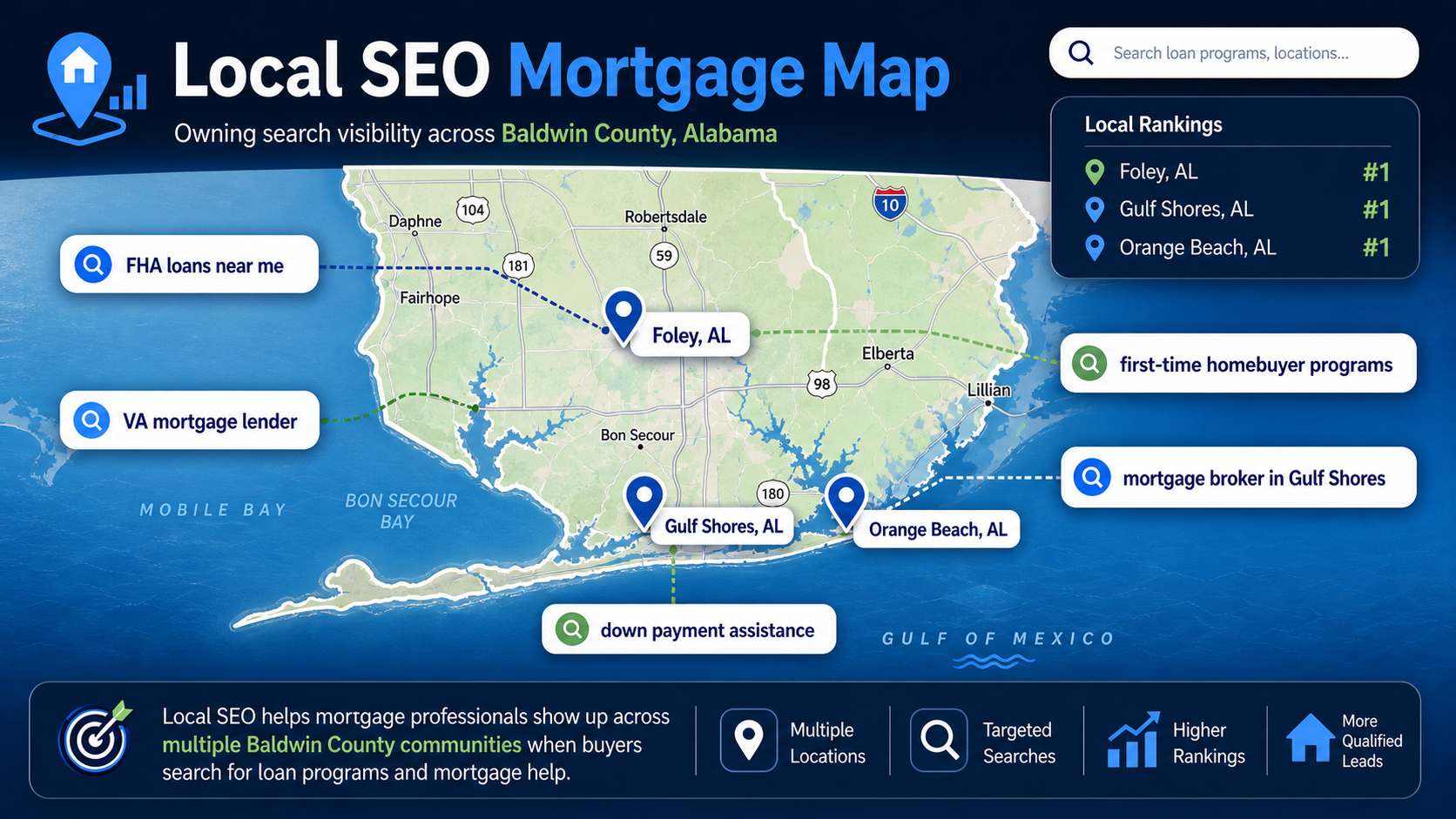
3. Create local SEO pages for your markets
Local SEO pages target borrowers in specific cities by pairing city names with loan types, local market content, and localized calls to action.
If you serve multiple cities or counties, a single homepage can’t rank for all of them. You need dedicated location pages-one for each major market-that are optimized for local search.
A strong local page includes:
- The city name and loan types in headings and body text
- Area-specific content: median home price, market conditions, down payment assistance programs
- Testimonials from borrowers in that area when possible
- Links to your Google Business Profile and local reviews
- A clear call to action with a local phone number or contact form
Local pages aren’t just good for SEO. They also signal to borrowers that you know their market and serve people like them.
4. Publish loan program content
Loan program pages for FHA, VA, DSCR, jumbo, and refinance attract higher-intent borrowers who already know what they need and are closer to applying.
Generic “mortgage broker” content competes with every bank, credit union, and broker in the country. Loan-specific content-DSCR loans, FHA loans, VA loans, jumbo loans, cash-out refinance-attracts borrowers who already know what they need and are further along in the decision process.
These borrowers convert at higher rates because they’re not in the early research phase. They’re looking for the right lender for their specific loan. If you’ve published a page explaining exactly how a DSCR loan works and what you require, and they find it through search, you’re already positioned as an expert before the first conversation.
See the full breakdown on how to approach this for investor clients: How to Generate DSCR Loan Leads.
5. Build referral partnerships with real estate agents
Real estate agent referrals generate high-quality purchase leads when brokers earn trust by making transactions easier, faster, and more reliable.
Real estate agents are still one of the most reliable and scalable referral sources for purchase loans. A single agent who closes 30 homes per year and consistently sends you their buyers can be worth more than most paid campaigns.
The challenge is that most mortgage brokers approach agents by asking for referrals before building trust. Agents want to partner with lenders who make their lives easier and protect their deals. Here’s how to earn those partnerships:
- Offer fast, reliable preapproval letters
- Communicate proactively throughout the transaction
- Provide co-branded buyer guides or market update content
- Show up for open houses when asked
- Never surprise an agent with a late denial or slow close
Start with three to five agents and focus on becoming their go-to lender before you expand.
6. Use Google Business Profile for local mortgage leads
A Google Business Profile helps mortgage brokers appear in local search results and map packs when borrowers search for lenders near them.
Your Google Business Profile (GBP) is often the first thing a local borrower sees when they search for a mortgage broker near them. It’s free and consistently underutilized.
To make your GBP work:
- Keep your services, categories, and hours accurate
- Collect reviews consistently-ask after every closing
- Post monthly updates, loan program information, or market content
- Answer questions in the Q&A section
- Add photos of yourself and your team
GBP reviews also feed directly into local pack rankings. More reviews, higher average rating, and regular engagement all improve your visibility in map results.
7. Run paid search for high-intent queries
Google Ads generates fast mortgage leads for high-intent queries at significant cost, making conversion tracking essential for measuring ROI.
Google Ads can generate mortgage leads quickly-faster than SEO-but the cost per lead is significant. Mortgage-related keywords are among the most expensive in any industry, with CPCs ranging from $10 to $50 or more depending on the query and geography.
The queries worth bidding on tend to be high-intent: “mortgage broker near me,” “FHA loan [city],” “DSCR loan lender,” “refinance mortgage rates today.” Broad terms like “mortgage” are expensive and attract a wide range of intent, including people who aren’t close to applying.
Before running paid search, make sure you have conversion tracking set up properly. If you can’t measure cost per lead and cost per funded loan, you can’t optimize.
8. Use Facebook and Instagram for retargeting and education
Facebook and Instagram work best for retargeting website visitors and educating borrowers rather than generating cold mortgage leads directly.
Social media rarely produces direct cold mortgage leads at reasonable cost. But it’s a strong tool for two things: retargeting people who have already visited your website, and educating local audiences who aren’t quite ready to apply.
Effective social content for mortgage brokers includes:
- Short educational videos: “How does a DSCR loan work?” “When should you refinance?”
- Local market updates: median price trends, rate environment
- Borrower success stories (with permission)
- Lead magnets tied to short-form video
For retargeting, a campaign that keeps your name in front of website visitors for 30 days can meaningfully increase conversion rates-especially for borrowers who are still in the research phase.
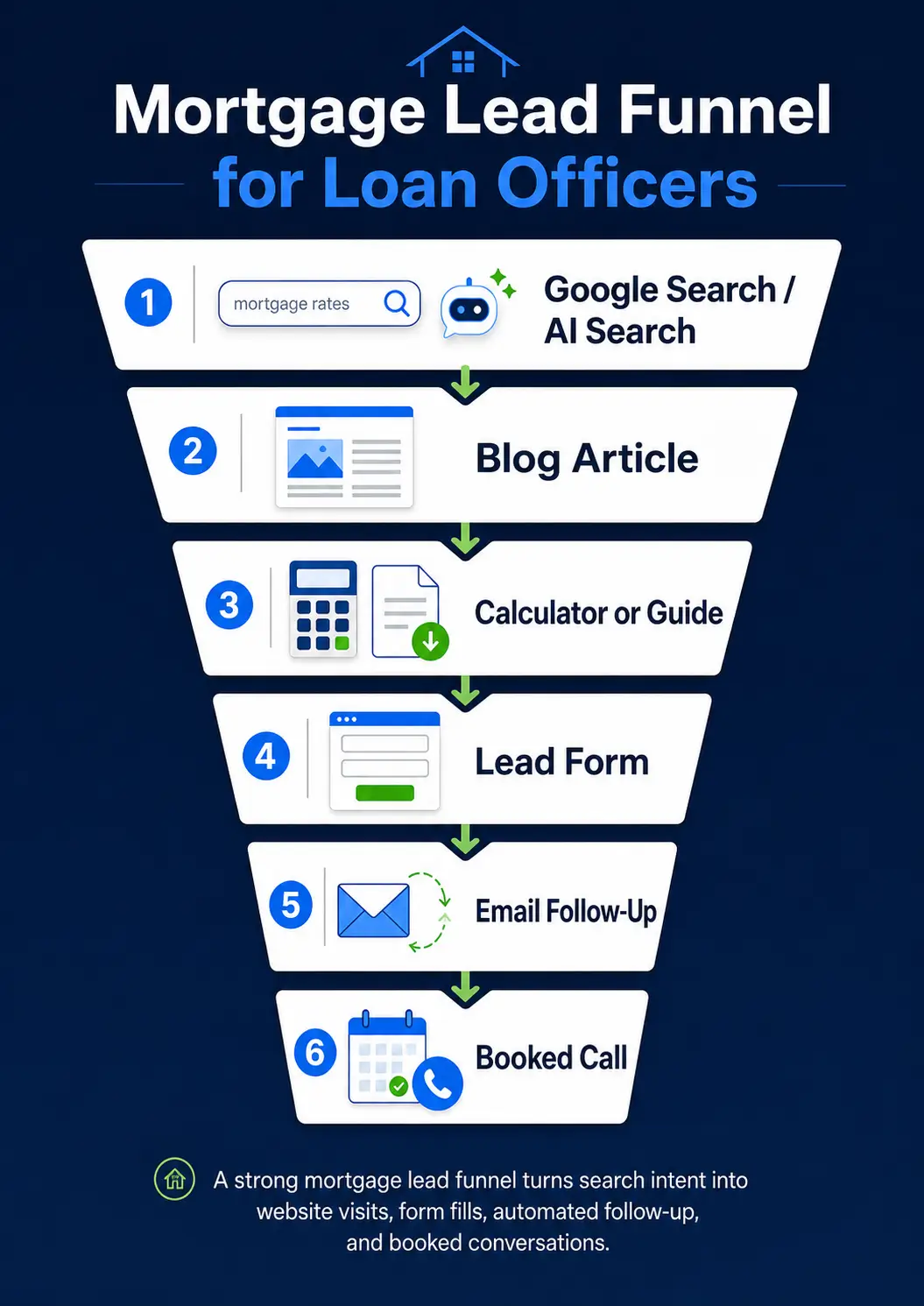
9. Create lead magnets for borrowers
Lead magnets-checklists, worksheets, and guides-capture borrower contact information and start the relationship before they are ready to apply.
A lead magnet is a piece of useful content you offer in exchange for contact information. For mortgage brokers, the best lead magnets match a specific borrower concern:
- First-time homebuyer checklist
- Refinance savings worksheet
- DSCR investor loan checklist
- Down payment assistance program guide
- Mortgage readiness self-assessment
A lead magnet doesn’t need to be elaborate. A one-page PDF with genuine utility will outperform a polished guide that says nothing specific. The goal is to give the borrower something worth trading their email for, and to start the relationship before they’re ready to apply.
10. Build email and SMS follow-up
Email and SMS follow-up converts more leads by staying in contact with borrowers who are not ready today but will apply in weeks or months.
Most mortgage leads don’t convert on first contact. A borrower who downloaded your refinance guide in March may close in August. A first-time buyer who asked about preapproval in January may buy in September. If you don’t have a system to stay in touch, you lose those borrowers to whoever follows up.
The basics:
- Use a CRM that can segment leads by loan type, stage, and timeline
- Set up automated follow-up sequences for new leads: email, SMS, or both
- Send monthly market updates or useful content to your long-term nurture list
- Track lead source so you know where your funded loans actually come from
Speed-to-lead also matters: contact leads within five minutes where possible. The contact rate drops sharply after the first hour.
11. Buy mortgage leads carefully
Purchased mortgage leads can work but depend on exclusivity, lead age, source quality, and fast follow-up to produce acceptable cost per funded loan.
Purchased leads can work, but results depend heavily on the source, exclusivity, age of the lead, and your follow-up speed. Shared leads from aggregators are the most common and the most competitive-you’re one of several brokers calling the same person.
Before committing to a lead vendor, ask:
- Are these leads exclusive or shared?
- How old are the leads when I receive them?
- What is the source? (Direct response, form fill, call transfer, etc.)
- What geography and loan types can I filter for?
- What is the refund or replacement policy for disconnected numbers?
For a full breakdown of how purchased leads compare to other sources, see the mortgage lead generation service and the comparison of exclusive leads vs. Zillow leads.
12. Focus on exclusive mortgage leads when possible
Exclusive mortgage leads cost more per lead but produce higher contact rates, better conversion, and lower cost per funded loan than shared leads.
When you’re buying leads, exclusivity matters. A shared lead that was also sent to four other brokers is not worth the same as a lead sent only to you. You’re competing on speed and price before you’ve even spoken to the borrower.
Exclusive leads cost more, but the economics usually work out: lower volume, higher contact rate, higher conversion rate, lower cost per funded loan. The key is still to verify the source and the freshness-exclusivity alone doesn’t guarantee intent or quality.
Learn more about exclusive mortgage leads and how they compare to shared lead sources.
13. Use niche mortgage lead campaigns
Niche campaigns targeting DSCR, FHA, VA, or jumbo borrowers generate higher-quality leads with less competition than broad mortgage lead campaigns.
Broad mortgage lead campaigns compete with every lender in your market. Niche campaigns-DSCR investor loans, VA loans for veterans, FHA for first-time buyers, reverse mortgages, jumbo purchase loans-let you reach borrowers who have a specific need and are more likely to match your product set.
Niche campaigns work across channels: dedicated landing pages for specific loan programs, Google Ads targeting loan-specific queries, social content that speaks to a specific borrower type, or referral relationships with professionals who serve that niche (property investors, veterans’ organizations, financial advisors).
The tighter your targeting, the lower your competition and the higher your conversion rate tends to be.
14. Track lead source and cost per funded loan
Tracking cost per funded loan by source shows which channels generate real revenue so brokers can cut low-performing sources and reinvest wisely.
Cost per lead is a misleading metric if you’re not also tracking what happens to those leads. A $20 lead that never contacts you is worse than a $150 referral that closes every time.
The metrics that matter:
- Contact rate by source (what percentage actually pick up?)
- Application rate by source (what percentage submit an application?)
- Funded loan rate by source (what percentage actually close?)
- Revenue per source (what is the average loan size and commission?)
- Cost per funded loan (total spend divided by funded loans from that channel)
With this data, you can cut underperforming channels and reinvest in what’s actually generating revenue-not just volume.
15. Build a 30-day mortgage lead generation action plan
A 30-day plan audits your website, updates core pages, publishes content, starts referral outreach, and activates CRM follow-up in four weekly phases.
If you’re starting from scratch or rebuilding your pipeline, here’s a practical framework:
Week 1 - Audit and fix the foundation Review your website for speed, mobile usability, and conversion issues. Make sure every page has a clear call to action and working form. Claim and optimize your Google Business Profile. Set up call tracking and form tracking.
Week 2 - Create or update your core assets Update your core service and location pages. Create or finalize one lead magnet for your primary borrower type. Make sure your CRM is set up with basic lead capture and follow-up sequences.
Week 3 - Publish content and start referral outreach Publish at least one loan program page or local SEO page. Email or call five real estate agents you’ve worked with before to reconnect. Ask three past clients for Google reviews.
Week 4 - Launch follow-up and measure Activate your email or SMS follow-up sequence. If you’re running paid ads, launch a small retargeting campaign to website visitors. Pull your week-one data: contact rate, response time, lead source breakdown.
This isn’t a magic four-week fix. It’s a way to stop doing random things and start building a system.
Which mortgage lead sources are fast vs. long-term?
Paid ads and purchased leads produce fast results at high cost. SEO, referrals, and content take longer but build low-cost, durable pipeline you own.
Every mortgage lead source sits somewhere on the spectrum between fast and durable:
The brokers with the most resilient pipelines combine at least one fast channel (paid ads or purchased leads) with at least one long-term channel (SEO, referrals, or content). The fast channel keeps the pipeline moving now. The long-term channel reduces your cost per lead over time and builds an asset you own.
What actually works for mortgage lead generation in 2026
The fundamentals of mortgage lead generation have not changed. What has changed is where borrowers go before they call.
In 2024 and 2025, AI tools became a primary research channel for mortgage borrowers. Borrowers are asking ChatGPT “who is a good local loan officer in [city]” and Perplexity “what do I need to buy a house with low income.” The loan officers whose content appears in those AI-generated answers have a first-mover advantage that most of the market has not yet pursued.
Three things that work specifically in 2026:
Local SEO with AI-ready content structure. Content that ranks in Google AND gets cited in AI Overviews requires both technical SEO fundamentals and Answer Engine Optimization. AEO means structuring content as direct answers to specific borrower questions so AI tools cite your page when a borrower asks a relevant question. See our answer engine optimization service for how this works in mortgage specifically.
Referral automation with content support. Real estate agents refer to loan officers whose online presence signals expertise and reliability. Co-marketing content, local market reports, and buyer education pages give agents something to share with their clients and create a consistent reason to send referrals your way.
Systems over tactics. The brokers who generate consistent leads in 2026 are not chasing the newest platform. They have a website that ranks, a GBP that converts local searches, a referral network that sends consistent volume, and a CRM that follows up automatically. Tactics change. Systems compound.
If you want help building that system for your market, see our mortgage marketing services page for a full overview of what we build and how.
How mortgage lead generation works in a high-growth regional market: a Gulf Coast example
The same lead generation principles apply nationwide, but they play out differently depending on local market drivers. Here is how they show up in one high-growth region, the Gulf Coast, where Tim built his own origination background.
Baldwin County, AL is one of the fastest-growing metros in the U.S., ranked 6th nationally in 2024 by the U.S. Census Bureau. The Daphne-Fairhope-Foley area added over 8,000 residents in a single year. That is a purchase market, not a refinance market. For loan officers serving Baldwin County, the highest-converting content focuses on FHA and USDA eligibility (large rural-eligible zones around Foley and Silverhill), first-time buyer programs, and local pricing data. Borrowers searching “what are homes selling for in Daphne” or “USDA loan Fairhope AL” have high purchase intent. A website with that content captures them. A generic template does not.
The Pensacola and Fort Walton Beach area runs on VA loan demand. NAS Pensacola and Eglin Air Force Base generate a consistent pipeline of active-duty relocation buyers and veterans purchasing in Okaloosa and Escambia counties. VA loan volume here is not seasonal. A loan officer without VA-specific content, eligibility pages, and certificate of eligibility guidance on their website is invisible to the single largest buyer segment in those markets.
The Mississippi Gulf Coast in Harrison and Jackson counties is anchored by Ingalls Shipbuilding, Keesler AFB, and a port economy that drives workforce relocation. FHA and VA purchase loans dominate. Gulfport and Biloxi buyers often ask hyperlocal questions about flood zones, elevation certificates, and wind insurance that a national lender’s generic FAQ will never answer. A loan officer who publishes that content owns the local search results.
The lead generation system is the same in every market nationwide: content that answers what borrowers search before they call, structured so Google and AI tools can cite it. What changes is the specifics. For a real-world example of what this produces in organic traffic, see the mortgage SEO case study. For the content structure that supports AI citations, see answer engine optimization.
FAQ: How to generate mortgage leads
What is the best way to generate mortgage leads? There is no single best way-it depends on your market, budget, and timeline. Most successful brokers combine SEO and website content for long-term organic leads with referral partnerships and paid ads for faster pipeline.
How do mortgage brokers get leads? Through a mix of sources: referrals from real estate agents and past clients, organic search traffic from their website, purchased lead lists, paid search and social ads, and outbound prospecting.
Can you generate mortgage leads for free? Yes, through SEO, Google Business Profile, referral partnerships, and social media content-but these channels take time to produce consistent results. “Free” usually means time investment rather than zero cost.
Should mortgage brokers buy leads? It can work as part of a broader strategy, but it carries risk if you rely on it entirely. Purchased leads are expensive and competitive. The economics work better when you focus on exclusive leads from quality sources and have fast follow-up in place.
What are exclusive mortgage leads? Leads that are sold only to you, not to multiple competing brokers. They generally cost more per lead but produce higher contact rates and better conversion rates.
How long does SEO take to generate mortgage leads? For most brokers in moderately competitive markets, consistent SEO work starts producing leads within three to six months. Competitive markets or starting from zero can take longer.
What are the highest quality mortgage leads? Referrals and organic search leads consistently convert at the highest rates because the borrower already has a reason to trust you before the first conversation.
How do I track mortgage lead generation ROI? Use a CRM to tag each lead with its source. Track contact rate, application rate, funded loan rate, and revenue by source. Calculate cost per funded loan for paid channels and compare it to your average commission.
Knowing how to generate mortgage leads is the easy part. The brokers who build a real pipeline do it by treating lead generation as a system: owned assets that compound over time, referral relationships that send consistent volume, and paid channels that fill gaps. They track what actually funds loans, cut what doesn’t, and reinvest in what works.
If you’re ready to move from random tactics to a consistent strategy, explore our mortgage lead generation service to see how we approach building that system. For organic search visibility, see our mortgage broker SEO service. Or if you want a full picture of what mortgage marketing looks like when all the pieces work together, see our mortgage marketing services overview.
Want us to build a lead generation system for your mortgage business? Book a free strategy call and we’ll walk through what a realistic pipeline looks like for your market and loan mix.